Monday, July 02, 2007

Stocktaking


Yesterday (Canada, Oh Canada, Day) we got a sunny afternoon so I went around the allotment and garden, camera in hand, to record the growth to date. This is the kind of list that nobody but me wants to read but I'm writing it as if someone will.
(a) A 12 foot row of climbing beans 'True Red Cranberry', after a slow start are now about 2/3 of the way up the pole, leaf amaranthe 'Kahulu' is over a foot tall, Roseval salad potatoes are in flower and 3 squash moschata 'Shishigatani' have vines 4 to 5 feet long.
(b) Corn 'Golden Bantam' (20 plants) is as high as an elephant's thigh (well knee maybe).
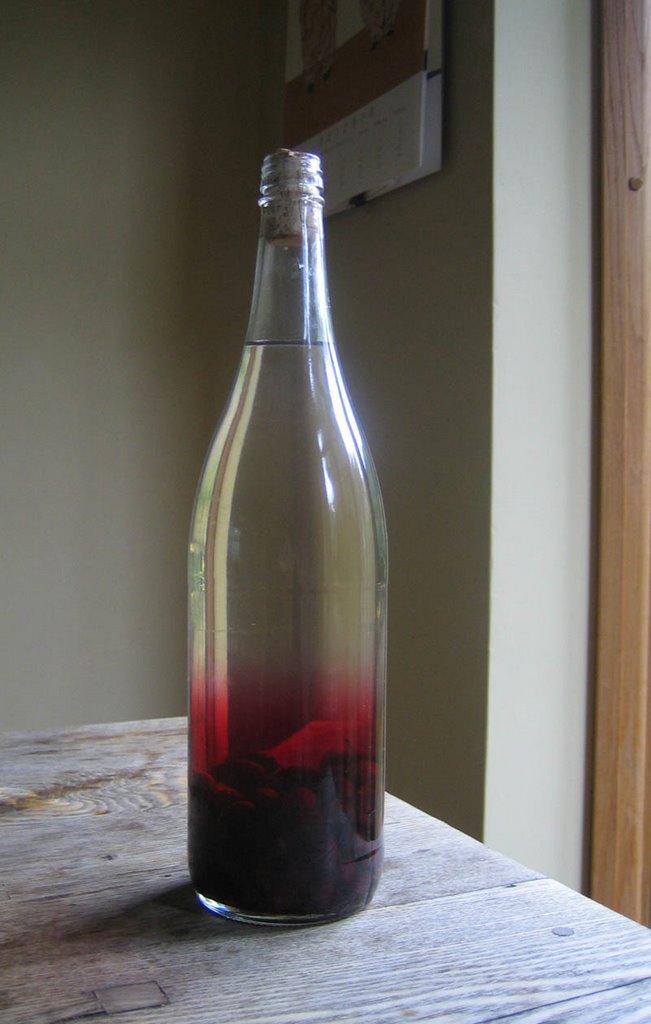
(c) Enough Morello cherries this year for 2 bottles of cherry schnapps methinks.
(d) Four courgette 'Costa Romanesca' are producing fruit now. I've also got three 'Albarellodi Sarzana' almost ready to plant out.
(e) One of 8 squash 'Blue Hubbard' in the foreground, some 'Weggiser' snap peas and a couple of the 10 'Green Globe' artichokes that I started for next year.
(f) Parsnips 'Half Long Guernsey' are looking hale while the cabbage 'Holland Late Winter' and brussels sprouts 'Groninger' behind are a bit pigeon-pecked.
(g)'Keswick Codlin' cooking apples will be ready in about 4 weeks.
(h) We're having salads most days to keep up with the lettuce which is thriving in this weather. In the top corner just visible are a few of the leeks I dibbed-in (?) 10 days ago - 30 'Swiss Giant Zermatt' and 45 'Siegfried'.
The cucumbers 'Kaiser Alexander' didn't get their picture taken because they have just sat and stared at me since I planted them out 4 weeks ago. Also not pictured but doing well are a dozen celeriac 'Giant Prague', 2 squash 'Marina di Chiogga', 5 squash 'Buttercup', climbing haricot beans 'Aunt Jean' and 'Soissons', dwarf bean 'Magpie' and 4 each of tomatoes 'Pink Brandywine', 'Yellow Pear', 'Stupice' and 'Isis Candy'. A dozen kale 'Nero di Toscana', 8 purple sprouting broccoli, and a dozen 'Westfalian' kale 5-6 inches in height got planted out yesterday. In modules 'Large Green' chard, corn 'Orchard Baby' and okra 'Beck's Gardenville' are about an inch high.
On Saturday I sowed a tray of lettuce 'Black Grained Simpson' and 'Craquerelle du Midi', more parsley and fennel 'Romanesco'. We have finished the early potatoes and are now on the 'Charlottes'. The 'Guerande' carrots that I thought had failed to germinate have just shown up and beetroot 'Devoy' and 'Lutz' have 2 true leaves.
Hmm, this diary could be useful in years to come if only I had kept a detailed record of sowing dates. Next year.

Thursday, June 28, 2007

More Artful Beetles


Three paintings by Joris Hoefnagel (1542-1600) which feature the stag beetle. More of his nature studies can be seen on the National Gallery of the U.S.of A. and at Giornale Nuovo.
Below is the ingenious folding new year's card that we got from Michael's uncle Werner who actually has a beetle named after him. I think it's one Coleoptera westfalia 'Starkei' - but not the one pictured below which is a chafer.

Wednesday, June 27, 2007

Has-Beans


Just polished off the last of the broad beans. In their final days the plants succumbed to chocolate spot and went downhill rather quickly - a disease of which I was hitherto unaware. The beans were still good but the foliage looked like it had been heavily dusted with cocoa powder, hence the name. It was a timely death. I need the space to plant out next spring's cabbages.
We have also been dining on some rather fine early potatoes and a few Charlotte salad potatoes AND the first courgette Costa Romanesque, a very deeply ribbed and crunchy specimen.
Alas, my first sowing of carrot seed has failed to germinate (sigh) so will have to try again. I suppose it was past it's sell by, but maybe I should be paying more heed to the lunar calendar. Peas and lettuce are happy but lots of plants (ie. cucumbers, beans and tomatoes) seem to be in a holding pattern while this bracing autumnal weather is occupying our June.

Tuesday, June 19, 2007

Pollenfarb


I've been sitting watching the bees to-ing and fro-ing today which can be very instructive when you have this conveniently pocket sized "Pollen Colour Guide" close to hand (click on it to make it readable). Right now their baskets are bright yellow (possibly the privet), bright orange (hopefully the lime trees which are in full flower right now) and pale sage (which is certainly the bramble in bloom everywhere). For the last three weeks of May the bees were busy in the 10 foot tall bush which I have now happily identified as Leptospermum scoparium otherwise known as Manuka or Tea Tree. While all (unheated ) honey is antimicrobial, manuka honey has been shown to be especially effective at killing a wide range of bacteria including the 'superbug' MRSA. So convincing is the research that even the mainstream medical profession is using it (once again) for wound dressing. Anyway, I've taken a dozen cuttings and will attempt to propagate a little hedge of tea tree for our bees.

Monday, June 11, 2007

Still Life with a Stag Beetle


Time again for these prehistoric looking beasts to take to the wing in search of love after having spent several years as a grub underground. I see few enough of them that it still gives me a thrill. I saw the first one of '07 last week and encountered a female on the road while cycling home last night. Looking like a helicopter transporting a freight car, the males don't so much fly as wobble through the air, navigating olfactorily towards a female up to a mile away. Maria Fremlin has posted some great photographs here of stag night shenanigans. Do have a look.
And if you see one the people at 'The Great Stag Hunt' would like to know.

Thursday, June 07, 2007

Hand Picked


In her cookbook, Alice B. Toklas recalls in the chapter 'The Gardens at Bilignin' that "The first gathering of the garden in May of salads, radishes and herbs made me feel like a mother about her baby - how could anything so beautiful be mine... there is nothing that is comparable to it, as satisfactory or as thrilling, as gathering the vegetables one has grown."
We've had the 'inlaws' staying with us this week and last night for dinner I nestled a Salad Nicoise on a bed of freshly picked leaves. Towards the end of the meal, a couple of slightly befuddled caterpillers made their way to the rim of Michael's father's bowl. I suppose I felt a bit like a mother about her baby - as it picks its nose.
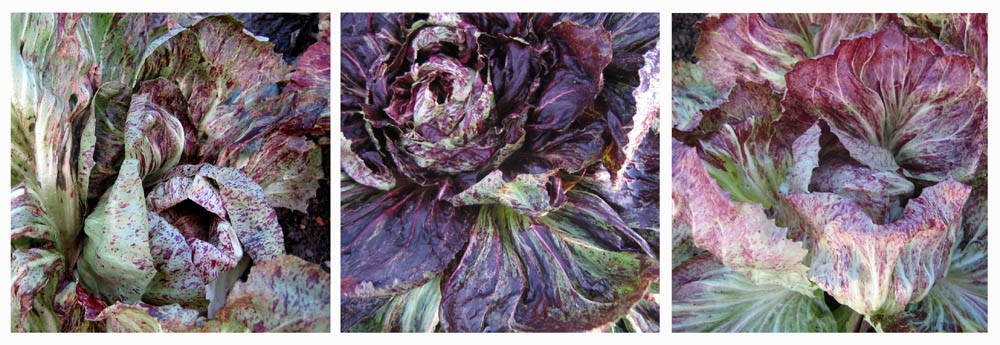
I'm still experimenting with different varieties but I like to keep a steady supply of these two (aka. Radichetta and Winter Density) from Kokopelli. They are good and crunchy and can be harvested over a long period.

Thursday, May 31, 2007

Apis mellifera


Well both colonies have laying queens now so things are looking up. Last week we even managed to find and mark the one that had emerged from the cells that Clive gave us.
Pictured above is a Victorian urinal at Thomas Crapper & Co. in Stratford (photographed in 'Toilets of the World'). The bee was printed onto the porcelain to give men something to aim at in a position that cut down on splashback. I have it on good authority that there are flies printed on the urinals at Schiphol airport, but the joke here was in the Latin name of the honey bee - apis.

Sunday, May 20, 2007

Growing Breakfast

Last summer I found a number of grains had germinated under the birdfeeder and I let them grow on. I realized how ignorant I am when it comes to identifying grasses/grains so I set about collecting and studying them, learning about awns and glumes and so on. The photos above are about as far as I got. Before long though I decided that I want to try to grow my own porridge (well,at least a few bowlsfull) and have now taken delivery of a packet of hulless oats and one of hulless barley. I did thresh (and thrash) the quarter cup of grain that grew last summer but the gruel was inedible - just a mouthful of hulls. These varieties should be easier to deal with. It's difficult to find much advice in any gardening books but I guess the idea is to sow it in September or thereabouts and harvest next June.

Sunday, May 06, 2007

Apple Update


Good news everybody, all three apple grafts have taken and are growing away nicely. The illustrations above are from the Herefordshire Pomona 1885 originally published by the Woolhope Naturalists Field Club. These are two varieties that I planted about 8 years ago and have been fruiting well (in restricted form) the past several seasons. The Keswick Codlin is very early - mid August - and makes a good sauce and the Ashmead's Kernal is a late dessert apple. The William Crump that I grafted is a late to very late (stored until March) high quality dessert apple and the neighbour's as yet unidentified cultivar is ready to eat end of August but is also good for pies.
I spent an afternoon at the RHS Lindley Library last week and unearthed this piece of advice from Leonard Mascall 1572 - " To cherish an apple tree throw al about your apple trees on the roots thereof, the urine of old men, or of stale pisse long kept, they shall bring forth fruite much better." For plum trees he suggests " the old pisse of old men, and dregs of wine, diluted with two parts water."
So, maybe the old pisse of some pissed old men would do the job.

Sunday, April 29, 2007

A Buzzy Day

This morning we cycled to Dorset Lane Allotments where Clive keeps his bees. He very kindly made us a cup of tea and provided us with 4 queen cells to put in our colony that has now been without a monarch for 3 weeks. Some of the workers have started to lay so we have to hope the colony will accept one of these when they emerge in the next few days. Then another stroke of good fortune, Mark on One Tree Hill Allotments only half a mile walk away had a swarm that he couldn't rehouse. So this evening we walked home 10,000 bees (that's when you want someone to try mugging you) and rehived them in the empty box. It's a happy sight to see them all troop up the ramp into the hive. Here's a little video we made of our first ever swarm.

Tomorrow our bee glade should once more be loud. And they can get on with making honey while the sun shines.

Thursday, April 19, 2007

Pied-à-terre


Robin's eggs on the grass, alas
I wish I felt more positive about the odds of their survival. I was just on the point of starting to uproot some of the brambles and sloes that are taking over when I found these in the grass (it's a good thing we haven't thought about strimming). I heard a tiny thrum and caught a glimpse of mother leaving which made me bend down for a look. They have narrowly avoided being flattened under my clogs but how will mother fend off the neighbours' cats, the foxes, squirrels and magpies once the little babies start to 'peep peep peep'...

...o.k. it's not completely secure, but they might have a fighting chance now.

Saturday, April 14, 2007

Thieving Magpie


Well, Easter has come and gone. And so too have the blackbird's eggs (sigh), again. Yesterday I was unhappy witness to the magpie winging away with the makings of a Turdus merula omelette in it's beak. The same thing happened last year. And then today it was clinging to the front of the tit box - flapping and pecking unsuccessfully at the entrance. It's a wonder we have any other birds in the garden. There are sound clips on the two links and if you compare and contrast I think you'll agree with me as to which one makes the better neighbour. The magpie's diet is made up of 'invertebrates, young birds and eggs, small mammals, fruits, seeds, berries and carrion.' So just about everything. In fact the medical term for a compulsive eating disorder (not necessarily of foodstuffs) - a pica - derives from Pica pica. They include slugs and snails on their menu though so they do have some merit for the gardener.

Thursday, April 05, 2007

HiHo! HiHo! ...


The allotment has just come alive again this week. The sun's been shining and the temperature is up around 18°. The broadbeans are in flower and I've got the first early 'Ulster Sceptre' and 'Roseval' salad potatoes in. I'll go back tomorrow and put in the other salad 'Charlotte' and maincrops 'Remarka' and 'Pink Fir Apple'. I've got hundreds of seedlings coming on in trays that I've been shuffling in and out of doors to catch the sun and it feels so good to finally be putting something in the ground. The half long guernsey parsnips that I started in modules (toilet rolls) are ready to get planted out now as I've just noticed the roots have found their way to the bottom. This may be quite a delicate business to get them in without damaging the tip. Otherwise I guess I'll have plenty of contestants for this year's ugliest vegetable competition.

Friday, March 30, 2007

Flower Power


This year I'm tiptoeing further into the hitherto unbeknownst territory (to me anyway) of flower growing. Apart from a few perennials - Aquilegia, Echinops and Iris - and some self seeding Nigellas, I've always stuck to vegetables. Last year I grew a row of Marigold harlequin and while not the most beautiful or fragrant flowers they are decidedly jolly and bloomed from June through to October.
My plan this year is to stud my greensward with blossoms creating a flowery mead such as you see in medieval tapestries. To that end I have just sown seeds of Cornflower Polka dot ("a dwarf strain with an outstanding colour range"), Eschscholzia Mission Bells ("Californian poppies in a range of bright colours") and Chamomile in trays in the window. Very exciting!
'Ful gay was al the ground, and quaint,
And powdred, as men had it peint,
With many a fressh and sundry flowr,
That casten up ful good savour.'

(as Chaucer put it)
I am hoping that if we time the semi-annual lawn mow to just prior to planting out, the flowers may have a chance to establish themselves. Later in the summer any grass cutting will have to be done with scissors I guess.

Saturday, March 24, 2007

Give Peas a chance


Hip, hip and huzza! Little green things are seeing the light of day now in the potting shed, full of promise for the season ahead. Tender, unblemished innocents unfurling, stretching up and fluffing out. Little do they know of the dangers that are lurking in ... The Great Outdoors! Squadrons of pigeons have fixed their beady eyes on the garden and the SAS (slugs and snails) are licking their lips(?) in anticipation of the salad days ahead. The overwintering eggs of assorted hostile forces have been incubating in record warm temperatures this year. For my brassicas - cabbage whites, whitefly and the cabbage mealy aphid form the axis of evil (axis of weevil?). And last year they took it in turns attacking my brussels sprouts. The RHS advice page on the cabbage mealy aphid warns that "the heaviest infestations occur from mid-spring until mid-autumn". Er... so, that would be all summer long then? I think that the mistake I made last year was to put a mesh around the sprouts early on to keep out the birds & butterflies (an exclusion zone), and all it did was keep the natural predators from feasting on the aphids. By the time I noticed them the first of the invasion force had already raised several generations and retired to condos down the stem. Trying to squish them all at that point without damaging the leaves is tiresome and not very effective. Is there any natural deterrent for these beasts? I don't buy into chemical warfare or scorched earth tactics.

Tuesday, March 20, 2007

A Regal Breakfast


The Plain Cookery Book for the Working Classes contains the following recipe: 'Oatmeal Porridge for Six Persons'
To five pints of skim or buttermilk, add a couple of onions chopped fine, and set them to boil on the fire; meanwhile, mix six table-spoonfuls of oatmeal with a pint of water or milk very smoothly, pour into the boiling milk and onions, and stir the porridge on the fire for ten minutes; season with salt to taste. It will be apparent to all good housewives that, with a little trouble and good management, a savoury and substantial meal may thus be prepared for a mere trifle.'
I cook my porridge in 1/2 measure milk and 1/2 water and I soak the (pinhead) oatmeal overnight in the water to reduce the cooking time. But at this time of year I add a chopped, (gloved) handful of fresh young nettle tops for a gruel that might not win the Golden Spurtle but is guaranteed to put hair on your chest.

Nettles aplenty in the back corner of the garden.

Friday, March 16, 2007

Hounds of Spring


The genius of James Thurber.

Wednesday, March 14, 2007

Saline Solution


I've been doing battle with a sore throat now for over a week, dousing it with honey, pots of tea, lashings of chicken soup and gargling with salt water. What I don't want to do is go to the doctor, have her glance at it and promptly write up a penicillin prescription, all within the 7 minutes allocated for an appointment. Does anyone know of a doctor who will take up his or her quill-pen, and scrawl out in spidery but legible longhand that 'the patient must take the waters in this or that spa town and not return until fully restored to health'? Send me details.
Over Christmas we visited Bad Rothefelde where generations of delicate Germans have been sent for their rest cures. The most amazing feature there is the 'Gradierwerk' or saline. This is a 30 foot high, 1/2 a kilometre long thatched wall built in the 18th century. The salt spring water is pumped up to the top and trickles down the blackthorn thatch, allowing evaporation and increasing the salt content from 4% to about 25%. Finally it is boiled down to extract the salt. There is a chamber inside the wall (very like a sauna, only cold so you leave your clothes on). It is filled with a dense fog of salt vapour which you inhale through your nose and exhale out of your mouth for 15 minutes at a time. And over time you will become the very picture of gesundheit.

If you click on the picture, you'll see the water trickling over the thatch and also some thatch encrusted with minerals which will get replaced in time. The longshot doesn't really do justice to it's size.

Friday, March 09, 2007

Hard Graft


I'm just back from Suffolk where I've taken a class in 'The Ancient Art of Grafting'. We employed the 'Side Veneer Graft' but could as well have used the old 'Whip and Tongue'. I brought home the fruit of my labours - Malus domestica 'William Crump' on MM106 and M26 rootstock - on the back of the motorcycle. They seem to have survived and hopefully in the next few weeks will give me a sign that they're willing to grow. I'm now eyeballing our neighbour's very tasty old apple tree and getting all sorts of mad ideas on how to transform the garden à la Axel Erlandson.

Oh, and talking about fruit trees, here's where you can petition our government to plant more fruit and other edible plants in public spaces.

Thursday, March 01, 2007

The Root of all Evil?


Platéarius writes in his 'Book of Simple Medicines' that "raw or cooked it [parsnip] is recommended for those who have just recovered from illness or melancholy". And goes on "with this herb one can make a kind of ginger candy which rouses lustful desires and aids digestion". Well, I only recently learned to like them and I think it was with good reason that a parsnip won the 'Ugliest Vegetable Competition' last year. I went to the allotment yesterday and dug up this quadrupedal specimen - the last of the 6 that made it to maturity. I don't know if the cause of the poor turnout was slugs or non viable seed but that's why I've decided to pre-germinate indoors and possibly even give them a start in modules this year. So I've just scattered some seeds on damp blotting paper today and we'll see how it goes.

Tuesday, February 27, 2007

Porrophagus

It begins to feel like spring now, what with the potatoes quietly chitting in the potting shed and yesterday I sowed a tray of seeds. Leeks - Giant Zermatt and Siegfried - this year. Last year I grew over 100 well-endowed "Mr. Lyon's" (Thomas Etty Seeds) and should have half a dozen to leave to flower and set seed for next year. Oh yes, does anybody out there know when is a good time to plant out the beetroot that I want to grow on for seed?
I also started to make some headway with the pruning and coppicing that I've been neglecting. After about 3 hours of that it was time for a sit down and a nice cuppa tea.

The tea council has a counter on it's site which allows you to watch the 190,000,000 cups of tea a day being, well, knocked back by the look of it.

Sunday, February 25, 2007

ToMayTo ToMahTo


There is a very good story about tomatoes in the last issue of Cabinet magazine, which can be read here (it's probably too late now to find the magazine still on the shelf).
I've got my seed packets fanned out in front of me - Pink Brandywine, Yellow Pear, Stupice and Principe Borghese - and I'm hurting my brain over whether to get them started a bit earlier this year. I have noticed on several blogs that people already have them germinating. Is this a good thing? Might it result in produce ahead of blight? Or are they going to be very leggy and weak? I usually don't get them started before the end of March. But then I've had to throw away half the crop (or more) the last few years when they succumb to the inevitable. Hmm...

Friday, February 23, 2007

World Cabbage Day


February 17th, it was. And I missed it! Where was all the jubilee, fanfare and bunting? It's one of the few things still going strong in the garden right now so I guess I'll go on celebrating it for the next month or two.
Last year I came across Cato's 'In Praise of Cabbages'. Firstly, he is most emphatic that "Cabbage surpasses all vegetables. Eat it either cooked or raw: if you eat it raw, dress it with vinegar. It aids digestion remarkably and does the bowels good, and the urine will be beneficial for all purposes." Mmm, and what could those be, you might be piqued to inquire? Well, "...store the urine of anyone who habitually eats cabbage; warm it, bathe the patient in it. With this treatment you will soon restore to health; it has been tested. Also, if a woman foments her parts with this urine, they will never irritate. Foment as follows: boil in a basin and place under a commode; the woman is then to sit on the commode, covering the basin with her clothing."
And just about any other ailment - insomnia, aching joints, septic wounds and nasal polyps can be treated with steeped leaves or ground cabbage potions.
There are some people who can be induced to vomit by just being presented with a plate of boiled cabbage, but ..." If you want to purge by vomiting, take 4 lbs. of the tenderest cabbage, divide into three equal bunches and tie. Then put a pot of water on the fire, and when it begins to boil plunge one bunch into it briefly. It will stop boiling. Then, as it boils, plunge the bunch again while you count to five, and take it out. Do the same with the second bunch, and then the third. Then put all together and pound. Remove into a linen bag, and express about a pint of juice into an earthenware mug. Add a salt crystal about the size of a bitter vetch seed, and roasted cumin seed enough to give flavour. Then put the mug outdoors, in good weather, overnight. The person who is to take the medicine should have a hot bath, drink honey water, and go to bed without dinner, then in the morning drink the juice and walk for four hours, and do any business required. When the urge comes and the nausea is felt, recline and vomit. So much bile and phlegm will be thrown up that the patient will wonder where it all came from. "

Tuesday, February 20, 2007

Happy Pancake Eating


I'm just thawing out after 10 days in a bleak and snow-driven Canadian outpost - the name of which apparently derives from the Mohawk word for 'where there are trees standing in the water'. It's got me thinking about chilblains. When was the last time you heard someone complain of a chilblain? Well at any rate I've come across this remedy should one be in need from Heath Robinson's 'Sicilian Char Woman'.
" ... and in his fifth year he developed a chilblain of the most painful description. Every remedy was tried, dried turnip seed, applications of roasted capers, poultices of wild figs and nard, fomentations of honey and turbot's roe, and many other recipes for the curing of chilblains, recommended by anxious friends. Nevertheless the blain grew chillier and chillier until at last they were compelled to send for a physician.
The physician, after spending a whole afternoon examining the foot, eventually took the most serious view of the case imaginable, and hastily wrote out the following prescription, promising to call again in a few days:
1 Pint New Gruel, 1 gr. Tincture of Green Acorns, 1/2 gr. Hypo, 1/16 gr. Castor Sugar, 3 Clove Kernels, 1/2 lb. Coffee Essence, 3/4 lb. Sugar of Zinc, 2 gr. Bisulphate of Lead, 1 Pint Spirits of Sulphur, 5 gr. Bicarbonate of Saltpetre, 1 oz. Table Salt.
Three drops to be mixed in a quart of lukewarm water and gently rubbed into the roots of the blain every five minutes, day and night, until it's disappearance, which, if all went well, should take place in about six month's time. "

Tuesday, January 30, 2007

Spuds U Like

Sunday was 'Potato Day' in our neck of the woods, and I've splashed out on what will be next year's crop. 'Ulster Sceptre' for the earlies, 'Charlotte' for second early salad, and 'Roseval','Remarka' and 'Pink Fir Apple' for the main crop. There were about 85 varieties on offer at our South London Seedy Sunday. But nothing as exotic (or poetic) as these Andean potatoes - a few of the thousands of varieties from whence they all originated.


A.Yana qhachun waqachi Black one that makes the daughter in law weep
B.quwi sullu Guinea pig's fetus
C.Yuraq pina White pineapple
D.Allqa rihra Like a two coloured shoulder
E.Kurqa sillun Clod of earth the shape of a fingernail
F.Kuntur warmi Like a woman with the colours of a condor's neck

Thursday, January 18, 2007

Blowin' in the Wind


Today my rain collector blew over so the last 5 days precipitation will go unrecorded. The last couple of months have been the windiest that I can remember. Many a night I lie awake listening to it, wondering when one of our trees will blow down. Maybe because it keeps me awake, I think that I am starting to become slightly unhinged by it, like those nuns in 'The Black Narcissus'. I hope I don't end up filling the allotment with flowers instead of vegetables this year, as the deranged Sister Philipa did.
Here's how they created the wind for the 'Himalayan' set somewhere in west London.

Sunday, January 14, 2007

Regicide

We have made one resolution for this year - the queen must die. Against the advice of the old pros in the LBKA, we didn't kill HRH last year. She had come to us the year before as a virgin (we named her Bess) and the thought of squashing her didn't appeal. One year on things feel different. We seem to have very swarmy bees and our original monarch decamped with half the colony while we weren't looking. We had been dutifully destroying queen cells as we found them, but one must have escaped notice, and then another. I think the new queens are poor layers - perhaps they weren't fed royal jelly from the start? Anyway we are going to order 2 new sovereigns in the spring, all spunked up and ready to lay eggs. The real difficulty is going to be in finding the old ones. We searched several times unsuccessfully over the summer - another reason I think they are runts - so they are still unmarked. Meanwhile I've got a pamphlet on mead making and I'm going to have a go with some of this year's taking.
Sunday, January 07, 2007

King of the Bean


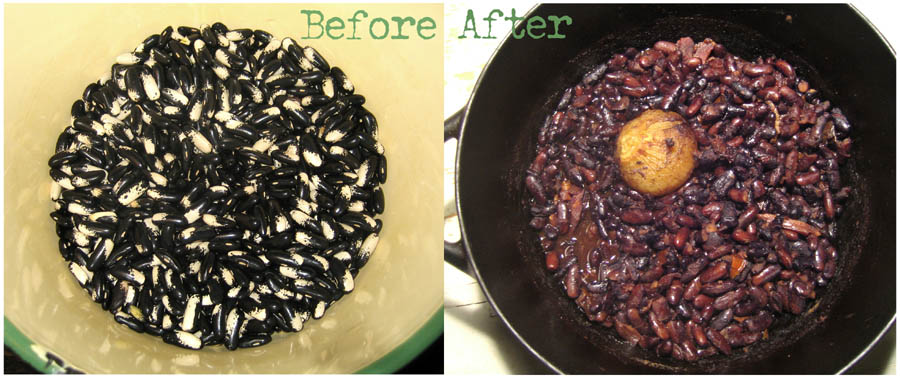
I've just cooked up the last of these beautiful 'Magpie' beans. This is a classic East coast Saturday supper dish 'Fundy Baked Beans' - guaranteed to put hair on your chest. I haven't been back to Canada since last spring, so had to substitute molasses for the maple syrup. Soak 4 cups beans overnight in 12 cups water. Boil next day with a bay leaf and an onion pierced with 4 or 5 cloves. If you've grown them yourself this won't take long (30 minutes or so), otherwise a couple of hours. As soon as the skin lifts off when you blow on it they're ready. Line the bottom of an ovenproof casserole pot with about a pound of smoked bacon. Put the beans on top. Get a fresh onion, roll it in 1 teaspoon dry mustard and bury it in the beans. Sprinkle with 2 teaspoons coarse salt. Pour 1 cup of maple syrup over top and add about 6 cups of the reserved (I should have mentioned that before you drained them) bean cooking water. Cover and put in a slow oven (gas mark 3/ 325° F) for about 5 hours. Keep checking to see that it doesn't dry out.
Here are the other beans I grew this year -

Sunday, December 31, 2006

Solstice Solace


'The Hemulen woke up slowly and recognized himself and wished he had been someone he didn't know... He crept under the bedcover and buried his nose in the pillow, then he shifted his stomach to the edge of the bed where the sheets were cool. He took possession of the whole bed with outstretched arms and legs, he was waiting for a nice dream that wouldn't come. He curled up and made himself small but it didn't help a bit... He tried to find something pleasant to think about that would drive away his morning melancholy, he tried and tried and gradually a friendly and distant memory of summer came to him...'
I've been reading Tove Janson's Moomin books lately. When I was little I remember getting them out of the library but I think I only looked at the pictures. Well they are chalk full of warmth and wisdom.
So today (yet another grey one) I will curl up comfortably with some seed catalogues and console myself with the thought that it's only four weeks until Potato Day/Seedy Sunday and the days are getting longer...

Thursday, December 28, 2006

Kohlfahrt


Here is what's on view right now on my allotment neighbour Luigi's plot. They looked just a bit festive. Radicchio I'm guessing.
This season generally triggers my gag reflex, and judging from the piles of sick that I tiptoe past on the way to work in Soho, it has the same effect on others. But on the plus side there is more time with friends and lots of good eating to be done. Which is why Thanksgiving gets it right - no present giving or papal waffle.
I'm just back from from celebrating Weihnacht in NordrheinWestfalen, near Münster. Along with all the Christmas markets, glüwein drinking and general bellringing I was initiated into the seasonal/regional 'grünkohlessen' experience. It is harvested after a few frosts from December through February. The kale is cooked with potatoes, onions and regional würsts, served up in a steaming mound and washed down with Weissen beer. I grew a lot of kale this year - cottagers and cavalo nero - and it's good to find new ways to cook it.
It's praises are sung on kohlfahrten.de. Here is a web translated exerpt...

Thursday, December 07, 2006

Saint Ambrosius Day


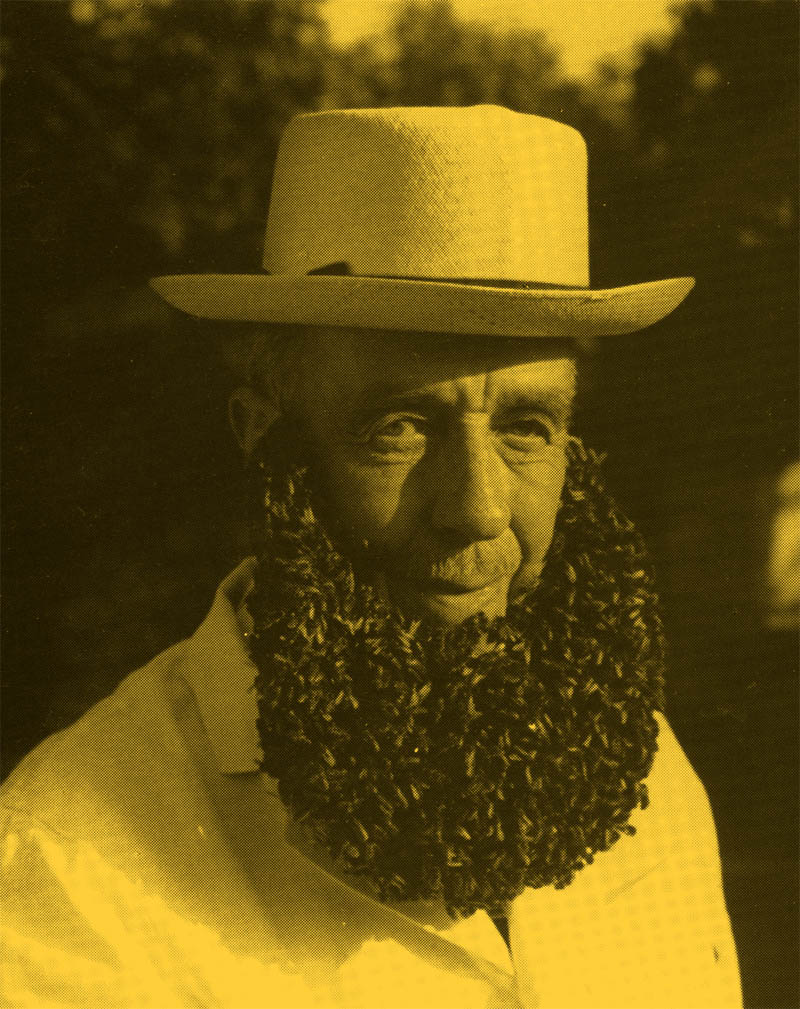
Wrap yourself around a cup of mead and toast the patron saint of bees, beekeepers, candle-makers and anybody else with a hairy eyeball. It's time for me to reflect upon this past summer in our bee-loud glade. I won't say that everything that could possibly go wrong did, because next year is bound to prove me wrong. Our bees were very swarmy and twice beflummoxed us before we mastered the art of bee wrangling. Once the third swarm was re-housed, the bees decided to build comb on the other side of the dummy board rather than on the frames provided. So, when next we lifted the roof, all we could do was watch in horror as their wild comb collapsed in on itself. Then, in August, the varroa mites moved in (quicker than we ever thought possible) and all but decimated the first hive's population.
Well, we've tucked them up for the winter now and, fingers crossed, we'll still have two colonies come spring. On the plus side there was this -

Thursday, November 30, 2006

Disembowelling

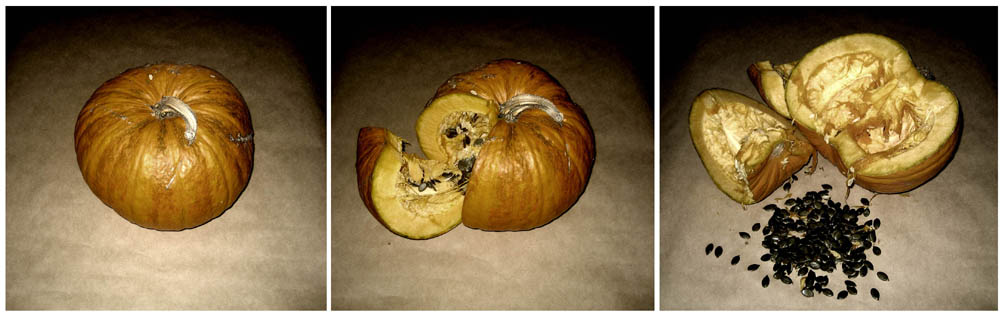
Well, I have delved into the first of my 6 Lady Godiva squashes - so called for they are naked seeded (hulless). And here is the payload, all 3 ounces of it.

I made the mistake of putting them on kitchen towel to dry. They are very sticky. It was as well there was no one around when I tore them all off again, re-soaked, cleaned them and laid them out - this time on an enamelled pan. The flesh ended up in a laksa pumpkin soup. Now I must study the entrails for portents of next season's harvest...

Monday, November 20, 2006

Class of 2006

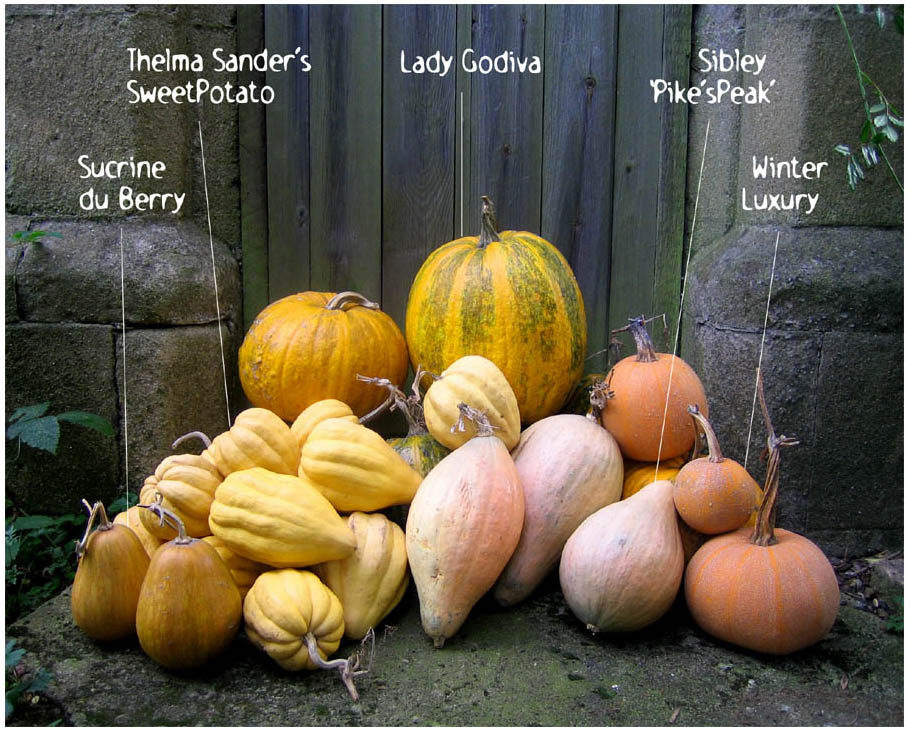
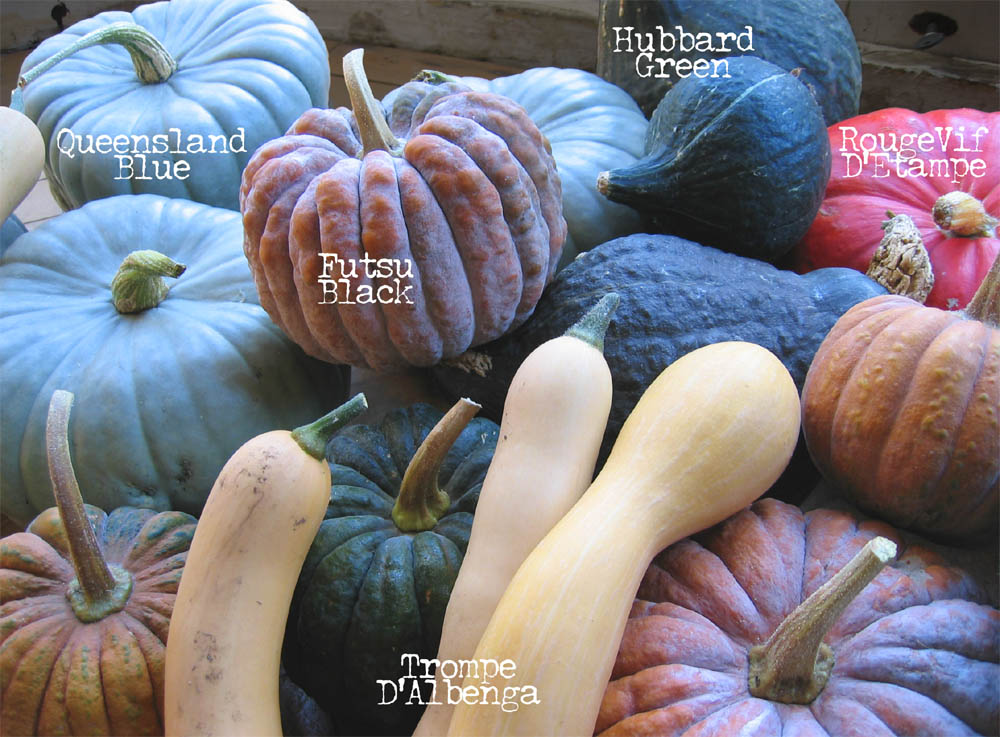
Every year I corral all my squashes together for a group photo. I left it a bit late this autumn, and all the blue and green ones have mellowed to give a slightly monochromatic result (shrug).

Last year's haul

2004

and 2003

I weigh them all as well, but I won't bore you with those details.

Monday, November 13, 2006

More Slow Food

Pictured below is 'Winter Luxury' squash which I grew this year - billed as one of the best for pie making. You just poke a couple of little holes in it and bake it at about 350 degrees Fahrenheit, until it slumps (or follow Gracie Allen's recipe for roast beef, substituting punkin - one large prime rib of beef, and a smaller rib of beef. Put both in the oven and when the smaller one is burnt, the big one is done.) Then get rid of the seeds, and scoop the flesh into your best punkin pie recipe. The one I am currently using calls for some grated fresh ginger, which I think ups the ante.

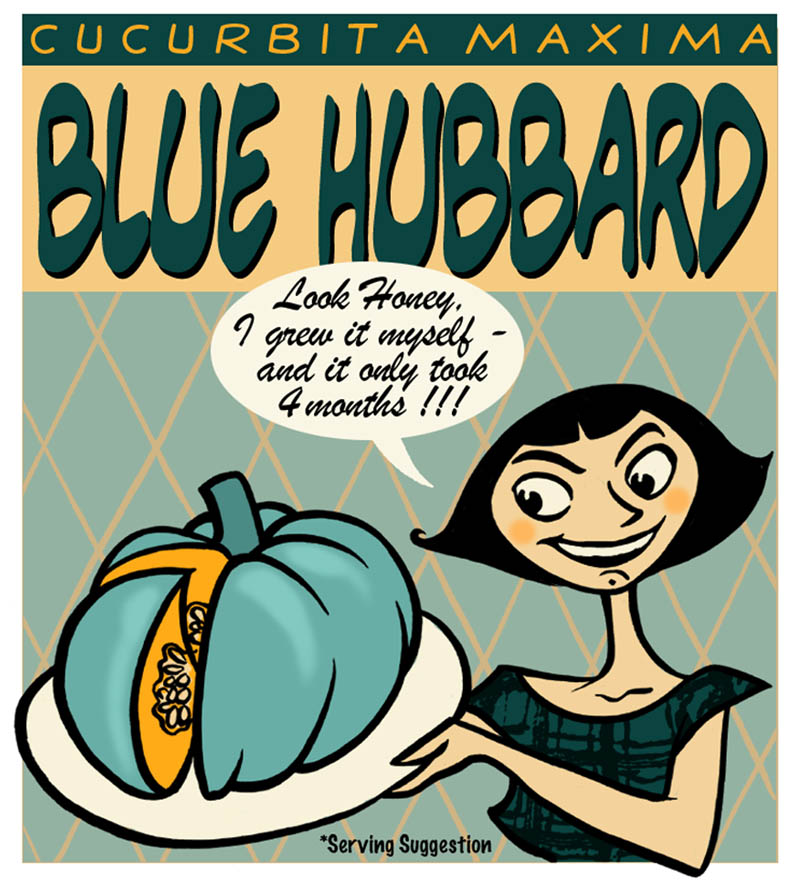
Anyway, last year I carefully saved seed from a 'Blue Hubbard'. I've made a label for the seed packet and I'm thinking of giving away a packet containing 5 seeds and a pie recipe to the first 50 people to subscribe to my soon to be announced magazine.

Friday, November 10, 2006

The Sloe Movement

We spent the past weekend on the South Downs - mostly walking (mmm, let's say putting one foot in front of the other on the homebound trek at 2 in the morning while surprising a sleeping grouse and more than a few cows along the way) , eating and drinking but also picking a shedload of sloes. The conditions were just right - frosty at night but bright sunny days. About a month ago I was very pleased to find just enough sloes on the lane leading to the allotment to make one bottle of gin. I picked them then and there because I knew that they would be gone by the time we had a frost in London. (Daddy Schlingmann wisely pointed out a few years ago that putting the fruit in the freezer overnight achieved the same end.) Anyway, there are now several gallons of the stuff, steeping quietly, in the far corner of the kitchen.